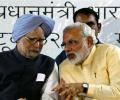
NDA under Mr Modi is as focused on the rural poor with doles and hand-outs as the UPA under Dr Singh was.

Dismissing the contention that the decline in inflation was on account of the steps taken by the NDA government, Chidambaram said he wanted to know, 'what measures were taken by the government that contributed to decline in inflation rates.'
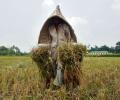
The focus is likely to be on consolidation and improvement of existing rural-centric programmes to ensure their completion ahead of the next general elections in 2019, rather than announcement of new schemes. Sanjeeb Mukherjee and Arup Roychoudhury report.

The total rainfall till now is not only deficient, but is also erratic in terms of both geographical spread and timings.

Economist Arvind Panagariya is the vice-chairman of NITI Aayog, while economist Bibek Debroy and scientist V K Saraswat are the two full-time members of the Aayog.
The number of centrally sponsored schemes have increased to 35 in FY22 from 30 in FY21 and central sector schemes have increased to 704 from 685 in the previous year, reports Dilasha Seth.

Even as India gears up for election results on May 16, a group of senior Bharatiya Janata Party leaders have taken up an informal initiative to see how a 'Modi ministry' will look like, in case the party forms the government at the Centre.

Various alleged administrative and financial irregularities worth crores have been pointed out in execution of development works in worst Naxal-hit Bastar district of Chhattisgarh by state Accountant General.

When KV Thomas took over as minister of state for food and consumer affairs (independent charge) on January 19, 2011, he was tasked with taking forward one single, important objective: expedite the implementation of the National Food Security Bill.

Leader of Opposition in Kerala Assembly Ramesh Chennithala demanded a judicial probe into the circumstances that led to opening of shutters of 40-odd dams at a time in the state.
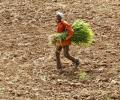
In spite of Budget's rural focus, the government has consistently stumbled in agriculture, says Shreekant Sambrani.

The Y V Reddy-headed commission said the states should use extra fiscal space for productive assets

With the fiscal deficit target staring at the government, the FY25 Budget has limited expenditure options, points out A K Bhattacharya.

A programme that endeavours to graduate the poorest people could have seminal implications for Prime Minister Narendra Modi's government.

While no specific state-oriented sops were rolled out, a strong thread of political wellness ran through the Budget.

India must be prepared to deal with climate disasters, geopolitical confrontations, and social strife linked to global events, asserts Jayant Sinha, chairman of Parliament's Standing Committee on Finance.

The finance minister has stayed true to her commitment to fiscal consolidation, even though the pace of the decline in the deficit could have been faster, notes A K Bhattacharya.
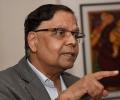
It raises three major questions - the incentive compatibility issue, the fairness issue and fiscal challenge, said Panagariya.

80-85 per cent of about 700 major infrastructure projects within the Centre's domain have been delayed.
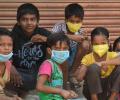
'Make sure you provide enough support (income, nutrition, healthcare, and housing) to migrants stuck (and their households), so they are not compelled to seek work or migrate back.' 'Otherwise, the risk of contagion is extreme.'
Instructions from the Union rural development ministry to the state officials on the WhatsApp group show that the chat was also used as an off-record avenue for the Union government to pass instructions, which it could not have done through formal channels, keeping the law in mind.

This will, of course, go a long way in meeting the promised fiscal deficit target of 3.6 per cent of GDP in 2015-16.

Could it have been more reformist? Of course, but this is an election year Budget, observes Akash Prakash.
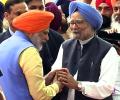
Whether it was the MGNREGS or the NFSA or the Aadhaar-based DBT scheme for cash transfer, the Modi government has built on the basic architecture created by the Singh government. Policy makers in the Modi government, instead of discarding them as products of the previous political regime, worked on them, expanded their scope and reach, and used new tools to improve their performance, explains A K Bhattacharya.

The government is doing things in agriculture that count for little, says Shreekant Sambrani.
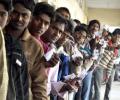
'Young Dalits are looking for better educational opportunities, more job avenues in the private sector, which need not necessarily mean job quotas, but a more welcoming corporate world that offers a liberated social environment, essentially a new India.'
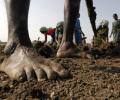
Data captured in central government records have a lag.

Modi also pitched for a social movement to ensure the safety of women and girls.
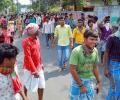
As the world awaits the end of the global pandemic, rural Bengal might be witnessing a recession unfolding in bits and pieces. With factories and tea gardens closing down, agricultural income falling and storm Aila ravaging a large part of deltaic West Bengal in 2010, migration gradually became a norm.

The notion that the BJP gained its increased tally by wiping out the Left parties and the Congress is completely misleading. Equally misleading is the belief that the TMC held its ground in all its existing seats. A little more than a fifth of the seats Mamata Banerjee's party had won in 2016 was lost to the BJP this time.

Finance ministry's drive is meant to meet fiscal deficit target and improve overall efficiency in government spending.

In a video issued by the Health Ministry, Dr Randeep Guleria, Director of the All India Institute of Medical Sciences (AIIMS) answered commonly asked questions regarding the dosage of the vaccine saying that two doses of the vaccine will have to be taken 28 days apart and protective levels of antibodies generally would develop two weeks after the second dose.

Kanika Datta explains why the Modi sarkar is gunning for non-profit organisations

The formula for success of farm economy is very simple -- farmers should be able to produce more from the same piece of land at reduced cost while minimising risk and be connected to market to get higher realisation for their produce, points out Siraj Chaudhry.

By any economic theory or doctrine, this is no Budget that supports economic recovery, whether through supporting aggregate demand, or through expansionary stimulus, declares Rathin Roy.

'There is no food to eat and water to drink and people are migrating in hordes.' 'Chief Minister Fadnavis must shift his base to Marathwada in such times.' 'If you do not help during a drought, then when will you help?'
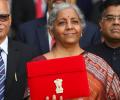
Had Finance Minister Sitharaman thought a little more about the middle class, disadvantaged sections, and the poor who are struggling, it would have been an inclusive Budget that would have made history, notes Ramesh Menon.
A number of significant linkages between rainfall and economic outcomes have policy implications.
The IIM-B's 'Karnataka innovation report' has become the basis for the Congress party's election narrative, particularly to distinguish it from the 'Gujarat model of development', reports Archis Mohan.
Centre's off-the-record instructions through WhatsApp and a squeeze on funds brought the rural work programme to collapse after a roaring first half of the year.
